
22 Apr
IFRS 9 to redefine risk recognition and absorption by banks
Dubai: Ahead of the introduction of International Financial Reporting Standards 9 (IFRS 9), a game-changer for banks across the world, UAE lenders need to prepare themselves to change the processes of reporting credit impairments, according industry experts.
The new regulation strongly affects the way credit losses are recognised in the balance sheet and profit and loss (P&L) statement. While impairments are currently based on “incurred losses”, IFRS 9 introduces an approach based on future expectations, namely expected losses (EL).
The main impact on banks is the need to recognise expected losses for all financial products, and at individual and grouped-asset levels. Banks will have to update their calculation at each reporting date to reflect changes in the credit quality of their assets. This will significantly increase the number and frequency of impairment quantifications that must be undertaken and the amount of data that must be processed for such purpose.
“IFRS 9 is a change that will significantly impact banks across the globe, as well as here in the UAE. In fact, the biggest accounting development for banks today is likely to be IFRS 9, as it will significantly impact balance sheets, accounting systems and processes,” said Yousuf Hassan, Partner, Risk Consulting at KPMG.
The new standard on risk recognition revises guidance on the classification of financial assets, and supplements the new hedge accounting principles published in 2013.
Guidance on impairment — that is, provisions for loan losses — are significantly different from current practice.
IFRS 9 will require recognition of losses by provisions to cover both already-incurred losses and some future expected losses.
If a bank provides a home loan, any number of events could result in a non-performing loan, such as the customer losing his job or suffering a serious injury.
“Under the current incurred credit loss model, the bank provides for a loan loss when such an event occurs. However, under the expected credit loss model, the bank is expected to anticipate that such an event could occur and therefore provide for losses earlier than previously,” said Hassan.
Adopting the new principles will require a lot of time, effort and money. The new standard requires banks to provide for expected credit losses over the lifetime of the loan on the date the loan is first recognised, based on the level of default expected over the next 12 months.
Where credit risk is assumed to significantly increase, loan-loss provisioning must be recognised based on the level of defaults expected over the expected life of the loan. This should lead to higher provisions, more complexity and deeper risk management involvement.
IFRS 9 is going to be a genuine paradigm shift for banks, not just in the UAE but worldwide. This is not an issue that affects only the finance or risk functions. The ripple effect of IFRS 9 will be felt across the organisation. Higher provisioning will force banks to review their capital requirements. Product mixes and business models will also need to be evaluated.
With a significant surge in provisions and its impact on profit and loss account expected, it will also be a big challenge for banks to plan ahead. Banks will need to factor this into their capital planning.
“We see only limited possibilities to cushion profit and loss from the worsening asset quality, given the implementation of IFRS 9 by 2019, which forces the bank to provision on expected losses, rather than incurred losses,” Jaap Meijer, head of Research at Arqaam Capital .
On the operational side, systems, processes and other infrastructure will need to change.
“Although the standard is applicable to accounting periods beginning on or after January 1, 2018, the changes are so pervasive and far reaching that, institutions should start acting now to comply with their requirements. Many, if not most, banks will require all of the time left to prepare for the expected credit loss requirements,” said Hassan.
Source: gulfnews.com/business/sectors/banking/ifrs-9-to-redefine-risk-recognition-and-absorption-by-banks-1.1832343

17 Feb
Massive 55% tax coming to the UAE
Good news for the UAE: No value-added tax (VAT) increases for upcoming 5 years.
UAE Minister of State for Financial Affairs Obaid Al Tayer said at the Arab Fiscal Forum the government has no plans to raise the rate of VAT or excise tax in the near future.
He was answering to a January note by S&P Global Ratings which believed some GCC countries may double the rate of VAT to 10% to raise government revenues, by between 1.7% to 2% of GDP.
Not so good news: The framework for corporate tax is under study, as per Al- Tayer.
Corporate tax is already applied on certain sectors but will now be expanded to include all UAE businesses.
We’ll get to that.
But what impact has the 5% VAT had or will have on the country?
No Impact: study
In a study, the Alliance Business Centers Network (ABCN) saidUAE businesses will be least affected by the imposition of VAT because it is one of the lowest rates in the world.
“Also the government will also be pumping back tax funds into the development projects which, in turn, will boost a number of industries in the country including investments in artificial intelligence, ICT and other traditional investment sectors,” says a new study.
Among Arab countries, the study showed that Tunisia imposes the highest VAT at 18%, Algeria 17%, Egypt 14% and Lebanon at 11%.
The ABCN report said Expo 2020 plans and projects will not be affected, evidenced by 2018 federal and local budgets showing government spending on development is increasing.
Some impact: JLL
Property consultancy Jones Lang Lassalle (JLL) said VAT in the UAE may impact parts of the real estate market in 2018, in particular the retail and office segments.
“Softer conditions and about 2% added to consumer prices will force landlords to take on additional costs, so if anything it’s going to be a negative, but not a big negative,” Craig Plumb, head of research at JLL Mena (Middle East and North Africa), told media last week.
While commercial buildings are subject to a 5% VAT, residential buildings are largely excluded.
Plumb said JLL witnessed an increase in real estate deal making in December 2017 before the tax came into effect.
“I think a lot of it was people bringing forward transactions to avoid the VAT, and January has been definitely a quieter month because of that,” he said.
Source: https://ameinfo.com/money/banking-finance/uae-vat-corporate-tax/
12 Feb
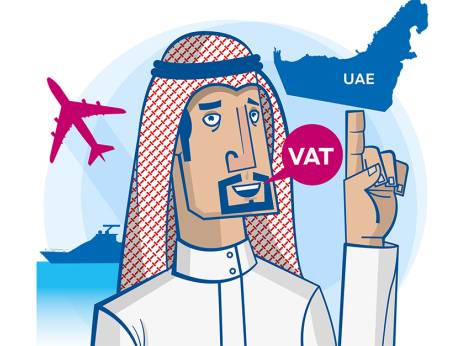
No plans to raise UAE VAT Rate in next 5 Years: UAE Minister
The UAE’s government has no plans to raise the rate of value-added tax (VAT) or excise tax in the near future, according to Minister of State for Financial Affairs Obaid Al Tayer.
“If you’re referring to the next five years, we don’t see anything [about] increasing the VAT rate of the excise tax,” Al Tayer told reporters at the Arab Fiscal Forum.
“I also want to confirm that there aren’t any subsidies or any legislation or any legislation regarding introducing income tax.”
However, Al Tayer noted that the UAE is in “the early stages” of studying the framework needed to implement corporate tax.
In a January note, S&P Global Ratings said it believed some GCC countries may double the rate of VAT to 10 percent to account for the difference between “statutory and effective tax rates”, which in turn would raise government revenues, on average, by between 1.7 and 2 percent of GDP.
Speaking at the forum, International Monetary Fund managing director Christine Lagarde said that the implementation of VAT “is an important step toward diversifying revenue and building tax capacity.”
“There is of course scope to do more as domestic revenues are very low, averaging only 10 percent of GDP,” she added. “This must be done with equity and fairness in mind, both of which are conditions for the acceptability of taxation.”
Source: www.arabianbusiness.com/politics-economics/389585-no-plans-to-raise-uae-vat-rate-in-next-5-years-says-minister

08 Feb
Minimal VAT impact on UAE Workforce
While most companies in the UAE will not take any specific measures to compensate against the introduction of VAT, a new study shows that VAT will only have a minimal effect on people’s buying power.
Mercer, a global consulting leader in advancing health, wealth and careers, and a wholly owned subsidiary of Marsh & McLennan Companies has released its latest research on the impact of VAT on the purchasing power of the UAE workforce.
“While VAT is applied to most items that are purchased on a daily basis, such as food, clothing and personal care, the so-called ‘additional spend’, which is made up of items such as financial services, education and flights are non-taxable,” said Rob Thissen, Talent Mobility leader for Mercer in the Middle East.
“Along with housing, these are accounting for a large proportion of employees spending power which will not be impacted by VAT. However, VAT will not affect everyone in the same way. Different individuals and households will have different spending patterns.”
Mercer research shows that income level and family size can cause the impact of VAT to vary considerably. For example, lower salary households living on an income of Dh100,000 would typically spend 48.5 per cent of their income on taxable goods and services, meaning a 2.4 per cent loss in purchasing power, while higher salaried single individuals with an income of Dh500,000 would only spend 37.7 per cent of their pay on taxable goods and services, decreasing the impact of VAT on their purchasing power to only 1.5 per cent.At the same time, Mercer’s study forecasts that VAT will be offset by the expected salary increases.Ted Raffoul, Career Products leader at Mercer in the Middle East said:
“While the VAT implementation will have a measurable impact on purchasing power, we forecast the average salary increase in the UAE to be 4.3 per cent across all industries, which is considerably higher than the expected level of inflation.
According to the IMF, inflation for 2018 is forecasted at 2.9 per cent. Inflation statistics already account for the expected consumer price increases, and most companies incorporate this figure while budgeting for salary increases.
Therefore, most companies feel no need for any extraordinary measures, but will likely monitor the situation closely as it evolves.”Industries such as life sciences and technology expect an even higher increase close to 5 per cent, while the energy and financial services sectors project salary increases closer to 3.5 per cent. – TradeArabia News Service
Source: www.gdnonline.com/Details/316754/VAT-impact-on-UAE-workforce-seen-minimal
